
The following is a tour of the 1840 s.f. Early Development Center that I have presented in schematic sketches. But, before we begin, it’s important to note that Waldorf classrooms have inhabited traditional vernacular, modern, and experimental types of buildings, old & new. The reason for a special ‘Waldorf’ design, is in the pedagogy itself. Rudolf Steiner developed a system of teaching that nurtures the soul within the child, and special care is taken to lead them into adulthood as fully aware, conscious people. In Waldorf design, it’s crucial to find balance between the ‘realms’ of above & below, right & left, and inside & out. Special attention is applied to the ‘feeling’ of spaces, especially for Early Development Centers. I also took this design opportunity to present a passive solar system. And now, the tour…
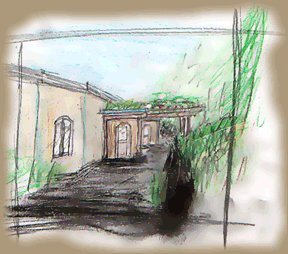
With each school day, the children are led by their parents from the parking lot to the school. The children are allowed to see the farmland, playground, and older children playing before entering the north corridor - protected by a grassy, wooded bank on the right, the firm presence of the school on the left, and trellises above. Their classroom’s entry invites them in with its three properties of grounding: the rock base, strong wood pillar, and heavy ‘living’ roof.
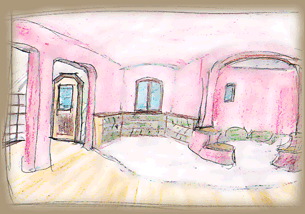
Once inside the scene is ‘domestic.’ The ceiling is low here, and there are thresholds to pass: thick lintels. The kitchen has a traditional home feel, and the proportions of spaces, passages, and fixtures, give the child the security of being in a friendly ‘home.’ The floor is wooden or tiled in the kitchen, entry, and art area, then carpeted with completely natural fibers at the story and play areas. The wall color is a peachy-pink lazure, warm and bright. Lazure painting is not opaque, but a ‘wash’ that allows more reflected light and sets a less dominating mood.
The core of the classroom is shared by the long table and play area, with a 9’ to 11’, slightly curving ceiling. The area of the table has abundant natural light and space for all their imaginations to share. The play nook is a place for a child to be independent. There are toys and books that lure a child to explore - in the corner of the room, with a view window for contemplation. Most removed is the story nook. Its circular shape, tucked away, is warm and calming. Here is where children nestle up on pillows and dreams away in perfect comforted posture.
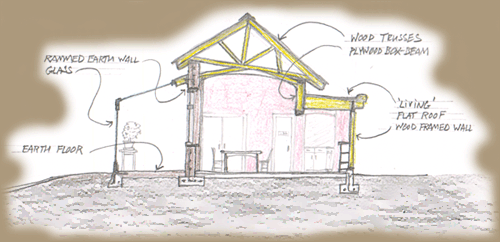
Moving away from the classrooms, out into the sunspace. The strategy with the passive solar gain of the sunspace is twofold. One justification is economical: to save approximately 50% in heating costs each year. The sunspace’s 900 s.f. of thermal mass surface area, and 400 s.f. of glazing (measured vertically), will yield a 45 SSF (Solar Savings Fraction). The SSF is the percentage of heating cost saved by passive solar heating in the puget sound region. Night insulation would add another 10% or so. The sunspace’s thermal mass is earth tinted, and may need to be darkened to achieve an absoptance of 80%, or more, of the sun radiating energy.
The other strategy of the sunspace is this: with the coming generations, children must inevitably experience the energy crisis. The intent here is to introduce the young ones to the beauty of harnessing the sun’s energy in a most peaceful and rewarding way. In the morning, the wall is cool, after school, it’s warm. Through this, a child can experience the movement of heat. No more are the days of hidden systems - too much ignorance has put our civilization in crisis. Children need to learn where our heat comes from, where our trash goes, and from where our water flows, then goes. Which leads me to another system…The drainage water from the roof should be channeled around the building to a pond with water-forms. In hearing the rain fall on the roof, then seeing the water splash around the building and well up in the pond, an understanding is being formed – a connection to the environment. With these low-tech systems, the children will be joyous and enlightened.
Lastly, the exterior form of the building is meant to be sculpture that enduces two reactions. The first sees its organic movement, like mushrooms and caterpillars. The second feels its ancient quality: stone carved by passing waters. Ultimately, the intention is…
mysticism – to keep imagination alive.
Special thanks to Bert Chase for giving me a tour of his North Vancouver Waldorf school and imparting his secrets of waldorf design.